Normal Labour Explained: A Step-by-Step Guide to Signs, Stages and Progress
Normal Labour Explained: A Step-by-Step Guide to Signs, Stages and Progress
Normal Labour Explained: A Step-by-Step Guide to Signs, Stages and Progress
Normal labour is the process in which progressive uterine contractions open and thin the cervix, allowing the baby to pass through the birth canal, followed by the placenta and membranes. The term eutocia refers to an uncomplicated birth.
Understanding labour requires more than recognising pain. Contractions, cervical changes, the baby’s position and the mother’s condition all contribute to how birth progresses. Preparatory symptoms may appear before labour begins, while the delivery of the baby is only one part of the process.
This step-by-step guide explains the meaning of normal labour, true versus false labour, the stages of childbirth, typical teaching estimates for duration, and the factors that influence progress. It is useful for students revising obstetrics and for families seeking a clear explanation of childbirth.
Medical note: This is educational information, not a means of diagnosing labour at home. Follow your maternity team’s individual instructions. If you think labour has started or are concerned about symptoms, contact your midwife or maternity unit.
What You’ll Learn
- True labour produces progressive cervical change, not merely painful uterine contractions.
- Labour progresses through cervical dilatation, birth, placental delivery and immediate recovery.
- The five Ps explain the physical and psychological factors influencing labour.
- Preparatory signs and duration estimates cannot reliably predict an individual’s birth timetable.
Table of Contents
- Step 1: Understand What Normal Labour Means
- Step 2: Distinguish True Labour from False Labour
- Step 3: Recognise Preparatory Signs Without Treating Them as a Countdown
- Step 4: Learn the Five Factors That Influence Labour
- Step 5: Follow the Stages of Labour by Their Start and End Points
- Step 6: Interpret Labour Duration as an Estimate, Not a Deadline
- Step 7: Understand How Hormonal and Mechanical Factors Work Together
- Step 8: Avoid the Common Mistakes in Interpreting Labour
- Step 9: Apply a Simple Observation and Revision Checklist
Step 1: Understand What Normal Labour Means
Labour involves coordinated changes in the uterus and cervix. The uterus contracts, the cervix becomes thinner and wider, and the baby moves down through the birth canal. After birth, further contractions help the placenta and membranes separate and come out.
Three terms make the process easier to understand:
- Contraction: Tightening of the uterine muscle followed by relaxation.
- Effacement: Shortening and thinning of the cervix.
- Dilatation: Opening of the cervix, measured in centimetres.
Pain may accompany contractions, but pain alone does not establish that labour is progressing. The important distinction is whether contractions are producing progressive cervical change.
What are the usual features of normal labour?
In traditional obstetric teaching, normal labour is associated with:
- A baby born at term.
- A vertex presentation, with the crown of the head presenting first.
- Spontaneous onset and progression.
- Completion without complications affecting the mother or baby.
These features describe an uncomplicated pattern. They are not a checklist that a pregnant woman can use to predict the outcome of birth. Whether labour remains uncomplicated requires ongoing professional assessment.
Likewise, “normal” should not be treated as a judgment about someone’s experience. A birth that needs intervention still requires the same careful attention to maternal and newborn well-being.
Term is not the same as full term
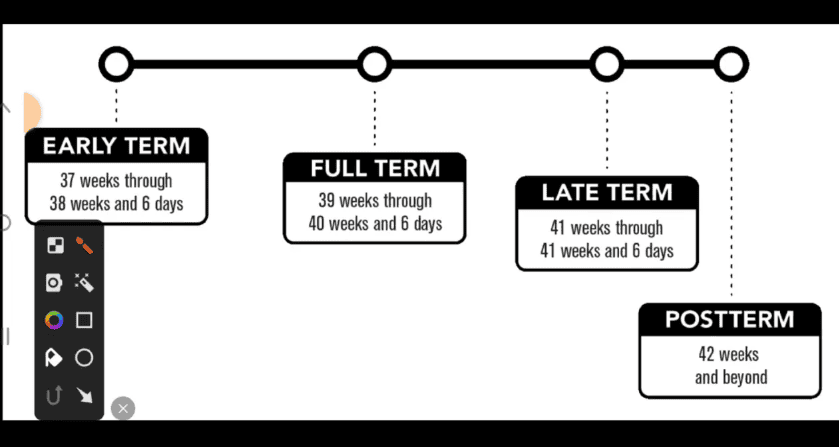
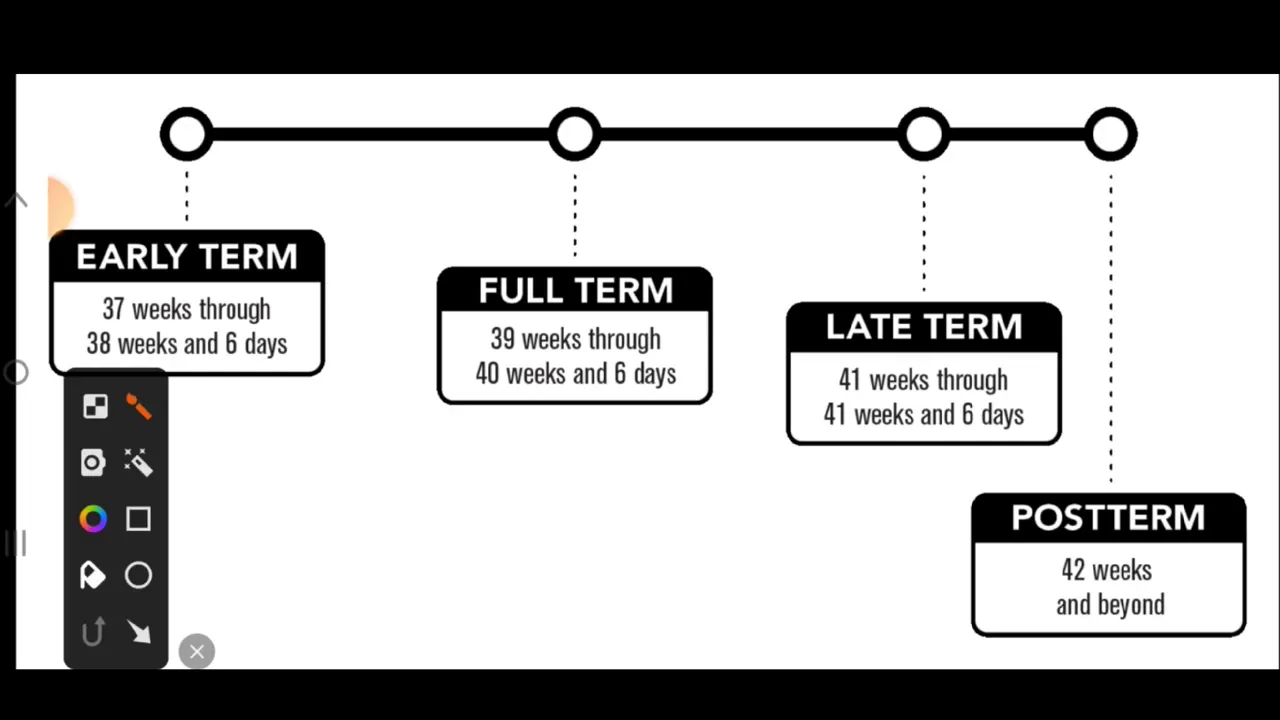
Gestational age is conventionally counted from the first day of the last menstrual period. The following categories distinguish different points near the end of pregnancy:
| Category | Gestational age |
|---|---|
| Early term | 37 weeks to 38 weeks and 6 days |
| Full term | 39 weeks to 40 weeks and 6 days |
| Late term | 41 weeks to 41 weeks and 6 days |
| Post-term | 42 weeks and beyond |
Full term is a specific category within the broader term period. It is, therefore, misleading to suggest that an uncomplicated birth can occur only between 39 weeks and 40 weeks and 6 days.
For formal terminology, see the American College of Obstetricians and Gynecologists’ definition of pregnancy.
Step 2: Distinguish True Labour from False Labour
The most useful difference between true and false labour is not simply how uncomfortable contractions feel. It is whether they become progressive and lead to cervical effacement and dilatation.
False labour contractions are real uterine contractions. “False” means that they are not establishing progressive labour, not that the discomfort is imaginary.
| Feature | True labour | False labour |
|---|---|---|
| Pattern | May begin irregularly, then become more regular | Usually remains irregular |
| Change over time | Contractions tend to become stronger, longer and closer together | No consistent progressive increase |
| Discomfort | May involve the lower back and spread around the abdomen | Often felt mainly in the abdomen |
| Response to activity | Usually continues despite rest or a change in activity | May settle with rest or a change in activity |
| Cervical effect | Progressive effacement and dilatation | No progressive labour-related cervical change |
| Mucus or show | May occur, but is not required | Its presence or absence does not settle the diagnosis |
Look for a developing pattern
A contraction pattern becomes more suggestive of labour when several features change together. Contractions become more regular, each lasts longer, and the intervals between them shorten.
For example, irregular tightenings that remain similar and then settle do not demonstrate the same progression as contractions that steadily become longer and more frequent. Neither example replaces clinical assessment.
Early true labour can still be irregular. An irregular beginning does not prove that contractions are false labour. Equally, a brief period of regular contractions does not establish how far labour has progressed.
Do not diagnose labour by pain location alone
Lower-back discomfort spreading towards the abdomen is a familiar teaching description of labour pain. However, experiences vary. Pain location is a supporting clue, not a definitive test.
The same caution applies to whether discomfort settles after rest. This can help describe a pattern, but it should not be used to dismiss concerning symptoms or delay contacting the maternity team.
Cervical change is the key clinical distinction
True labour progressively changes the cervix. Assessing those changes is a clinical task. It is not something to confirm by attempting a vaginal examination yourself.
A practical approach is to describe the timing, duration, and progression of contractions, then seek guidance rather than making a final diagnosis based on a single symptom.
Step 3: Recognise Preparatory Signs Without Treating Them as a Countdown
Premonitory signs are changes that may appear as the body prepares for childbirth. They can help explain late-pregnancy symptoms, but they do not reliably tell you the exact day or hour that labour will begin.
Lightening or the baby moving lower
Lightening describes the baby descending lower into the pelvis. The abdomen may appear lower, and pelvic pressure may become more noticeable.
This change can precede labour by some time. It is better understood as preparation than as proof that birth is immediately approaching.
More frequent urination
Pressure from the descending fetal head on the bladder can increase the urge to pass urine. This symptom belongs to the overall late-pregnancy picture, but it does not establish labour on its own.
Braxton Hicks contractions
Braxton Hicks contractions are intermittent uterine tightenings that can occur during pregnancy. Towards the end of pregnancy, they may become more noticeable or uncomfortable.
They usually lack the sustained progression associated with established labour. Their intensity alone is not enough to distinguish them from early true labour.
Cervical ripening and effacement
Cervical ripening means that the cervix becomes softer and more ready to open. Effacement means it becomes shorter and thinner.
These changes are related but not identical:
- Ripening: The cervix softens and becomes more favourable for labour.
- Effacement: Its length and thickness decrease.
- Dilatation: Its opening widens.
A useful study rule is to associate effacement with thinning and dilatation with opening. Do not use the terms interchangeably.
Increased mucus and a show
As the cervix changes, cervical mucus may be released. The mucus plug can come away, sometimes with a small amount of blood mixed into it. This blood-streaked mucus is commonly called a show.
A show suggests cervical preparation or change. It does not prove that active labour has begun, and labour does not require a noticeable show.
Do not assume that all vaginal bleeding is a sign. More substantial bleeding requires prompt advice from maternity services.
Nesting behaviour
Some women feel an increased urge to prepare the home, arrange baby clothes or organise belongings before birth. This is often described as nesting.
It may be part of the experience of preparing for a baby, but it is not a diagnostic sign. Its presence cannot predict labour, and its absence does not suggest a problem.
The practical lesson: Preparatory signs indicate change, not a precise timetable. The developing contraction pattern and professional assessment are more useful for understanding labour progress.
Step 4: Learn the Five Factors That Influence Labour
The “five Ps” provide a simple framework for understanding why labour progresses differently from one person to another: passage, passenger, powers, position and psyche.
Some teaching systems use the three Ps: passage, passenger, and powers. Others add psychological factors and maternal position. These are variations of the same basic framework.
Passage: The route through which birth occurs
The passage includes the bony pelvis, cervix, pelvic floor, vagina and vaginal opening. Labour depends on both the available space and the soft tissues’ ability to adapt.
Traditional descriptions classify pelvic shapes as gynecoid, anthropoid, android and platypelloid. The gynecoid pelvis is generally described as favourable for vaginal birth.
However, a named pelvic shape should not be treated as an automatic prediction of delivery mode. The relationship between the passage, the baby and actual labour progress matters more than a label alone.
Passenger: The baby’s orientation and presenting part
The passenger is primarily the baby. Several terms describe how the baby is positioned in relation to the mother and the birth canal.
| Term | Meaning |
|---|---|
| Presentation | The part of the baby that enters the pelvic inlet first |
| Lie | The relationship between the baby’s long axis and the mother’s long axis |
| Attitude | The relationship of the baby’s body parts to one another, such as flexion or extension |
| Position | The orientation of the presenting part within the maternal pelvis |
| Station | The level of the presenting part relative to the maternal ischial spines |
These terms answer different questions. The presentation asks what part comes first. Lie asks how the baby’s body is aligned. Station describes how far the presenting part has descended.
In a vertex presentation, the crown of the head presents first. Fetal flexion and the orientation of the head also matter, so “head first” is not the complete description.
Powers: Contractions and pushing
Uterine contractions are the primary powers of labour. They help thin and open the cervix and move the baby downwards. During the second stage, maternal pushing also contributes to the birth process.
When describing contractions, distinguish:
- Duration: How long one contraction lasts.
- Frequency: How often contractions occur.
- Intensity: How strong the contractions are.
These characteristics help describe labour, but none should be interpreted in isolation. More frequent contractions do not automatically mean that labour is progressing normally.
Position: The mother’s posture
Here, “position” refers to maternal position, not fetal position. A mother’s posture during labour and birth can affect comfort and the circumstances of delivery.
There is no single posture that suits every situation. Preferences should be discussed with the care team, taking account of comfort and clinical needs.
Psyche: Confidence, stress and support
The psychological experience of labour includes confidence, fear, stress, the surroundings and support from caregivers. Clear explanations and reassurance are important parts of care.
This factor must not be used to blame a mother for slow progress. Labour involves physical and clinical factors as well as emotional experience. Support is valuable whether labour remains uncomplicated or needs intervention.
Step 5: Follow the Stages of Labour by Their Start and End Points
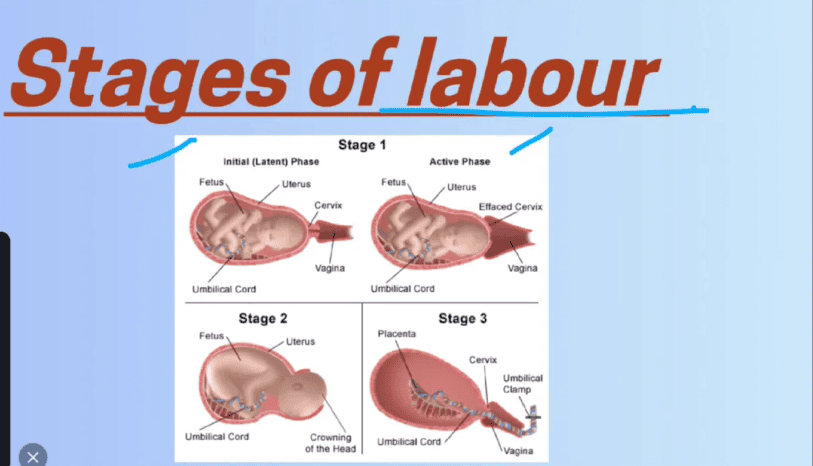
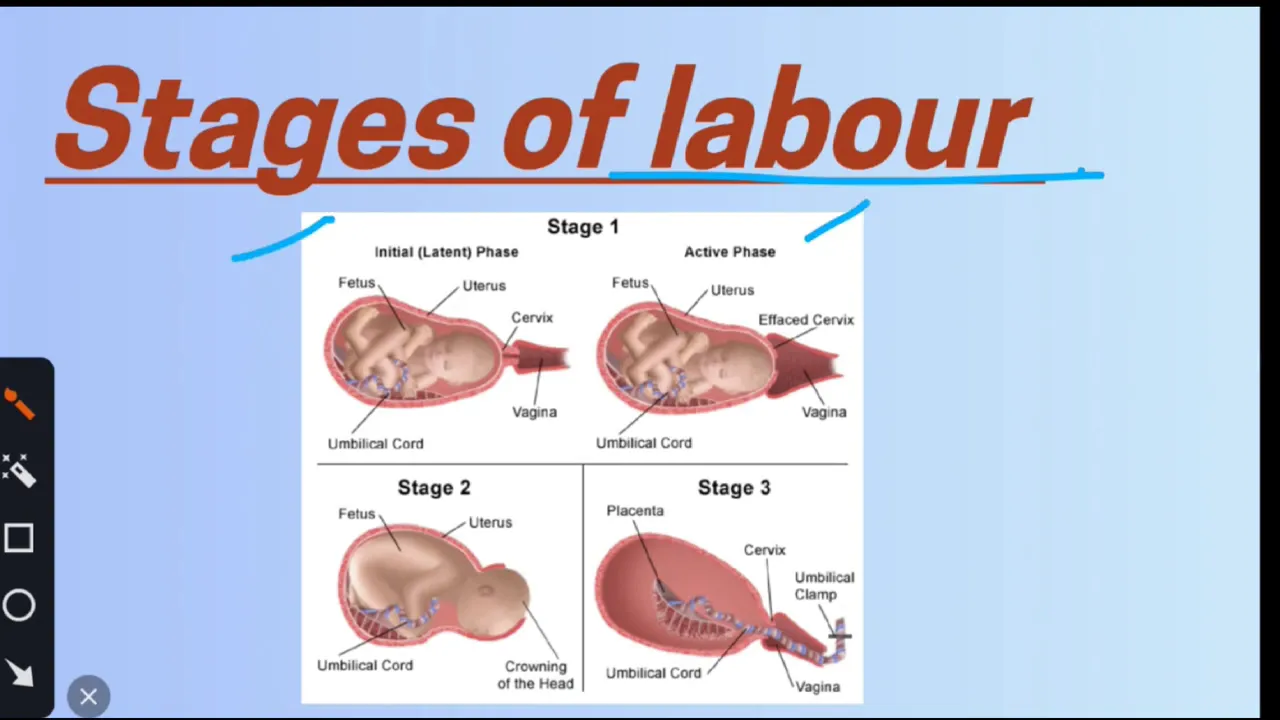
Labour is commonly described as three stages, with an immediate recovery period often taught as a fourth stage. The clearest way to remember them is by the event that ends each stage.
| Stage | Begins | Ends |
|---|---|---|
| First stage | Onset of true labour | Full cervical dilatation |
| Second stage | Full cervical dilatation | Birth of the baby |
| Third stage | Birth of the baby | Delivery of the placenta and membranes |
| Fourth stage or immediate recovery | After placental delivery | Completion of the initial observation period |
First stage: The cervix thins and opens
The first stage begins when true labour starts and continues until the cervix is fully dilated, approximately 10 centimetres.
It includes a latent phase and an active phase. During the latent phase, early cervical changes occur, and the contraction pattern may still be developing. During active labour, contractions and cervical dilatation become more established.
Older teaching materials may define 3 centimetres as the threshold for active labour. That threshold should not be presented as a universal current clinical rule. For example, ACOG’s guidance on first- and second-stage labour management defines the start of the active phase as 6 centimetres.
For study purposes, the essential distinction is that latent and active labour are phases within the first stage. Neither is a separate numbered stage.
Second stage: The baby is born
The second stage begins at full cervical dilatation and ends with birth. Uterine contractions, together with maternal pushing when appropriate, help the baby descend through the birth canal.
Crowning describes the head becoming visible at the vaginal opening as birth approaches. It is an event within the second stage, not the definition of when that stage starts.
Do not confuse full dilatation with completion of birth. Full dilatation marks the transition from the first stage to the second.
Third stage: The placenta and membranes are delivered
The third stage begins after the baby is born. The placenta separates from the uterine wall and is delivered with the membranes.
The baby’s birth, therefore, does not complete all the stages of labour. Placental delivery remains an important part of the process and requires professional care.
Fourth stage: Immediate recovery and observation
The immediate period following placental delivery is often called the fourth stage. It focuses on early recovery and observation as the uterus continues to contract.
Some introductory teaching descriptions focus on the first hour. This should not imply that recovery or monitoring ends exactly one hour later. The duration of observation depends on clinical circumstances and local practice.
A simple memory sequence is: cervix, baby, placenta, recovery.
Step 6: Interpret Labour Duration as an Estimate, Not a Deadline
Labour commonly takes longer during a first birth than during subsequent births. However, individual variation means that a teaching average cannot predict the course of a particular labour.
Traditional introductory estimates are often presented as follows:
| Stage | First-birth teaching estimate | Subsequent-birth teaching estimate |
|---|---|---|
| First stage | About 12 hours | About 6 hours |
| Second stage | About 2 hours | About 30 minutes |
| Third stage | About 15 minutes | About 10 minutes |
These figures are illustrative teaching estimates, not current diagnostic limits or instructions for waiting at home. They help explain the general tendency towards a longer first labour, but they are not a clinical timetable.
Why a single maximum is misleading
A rigid statement that normal labour must finish within 18 hours oversimplifies how progress is assessed. Total duration alone does not explain the stage reached, cervical change, descent or the condition of the mother and baby.
A more useful set of questions is:
- Which stage or phase is being measured?
- Is the cervix changing over time?
- Is the presenting part descending?
- What does the contraction pattern show?
- How are the mother and baby doing?
Timing is part of assessment, but it does not replace these other observations.
Use pregnancy and birth terminology carefully
Primigravida means a woman in her first pregnancy. Multigravida means a woman who has been pregnant more than once.
These terms count pregnancies, not previous births. They should not automatically be substituted for “first birth” and “subsequent birth” when discussing labour duration. That distinction is particularly useful when writing exam answers or reading clinical records.
Step 7: Understand How Hormonal and Mechanical Factors Work Together
Labour onset is not explained by one hormone acting alone. Hormonal signals, uterine responsiveness, cervical preparation and mechanical stimulation interact.
The clearest approach is to learn the main function of each factor before trying to memorise a detailed pathway.
Progesterone: Maintaining uterine quietness
Progesterone helps maintain pregnancy and restrain uterine contractility. It is produced initially by the corpus luteum and later by the placenta.
Near labour, the balance shifts away from this pregnancy-maintaining influence. In humans, it is more accurate to discuss changes in progesterone action or functional withdrawal than to assume a simple, universal fall in its blood level.
Estrogen: Increasing readiness for contraction
Estrogen-related effects increase the uterus’s readiness to respond to contractile signals. These include changes in oxytocin responsiveness and support for prostaglandin-related activity.
The practical concept is increased sensitivity: the uterus becomes more responsive to signals that promote labour.
Oxytocin: Stimulating uterine contraction
Oxytocin is released from the maternal posterior pituitary. It acts on the uterine muscle to promote contractions and can also contribute to prostaglandin release.
Its effects depend on uterine responsiveness, not only on the amount of hormone present. Receptors and the surrounding hormonal environment are therefore part of the explanation.
Prostaglandins: Supporting cervical and uterine changes
Prostaglandins are produced in tissues including the placenta, fetal membranes, decidua and uterine muscle. They contribute to uterine contractions and cervical preparation.
For revision, remember two related effects: the cervix becomes more ready to open, and the uterus becomes more capable of contracting.
Fetal hormonal signals
A commonly taught pathway links the fetal hypothalamus, anterior pituitary and adrenal glands. Hypothalamic signalling stimulates pituitary ACTH secretion, which in turn stimulates the fetal adrenal glands to produce cortisol.
This pathway illustrates the fetus’s contribution to the hormonal environment associated with birth. It should not be treated as a complete explanation or an exact clock that starts labour on a particular day.
Mechanical stimulation and neural feedback
As pregnancy advances, the growing baby stretches the uterus. Pressure from the presenting part on the cervix also contributes to mechanical stimulation.
Cervical stretch can participate in neural feedback associated with oxytocin release, often described as the Ferguson reflex. This connects the mechanical and hormonal aspects of labour.
Alpha- and beta-adrenergic receptors are also discussed in teaching descriptions of uterine contractility. Their inclusion reinforces the broader point that uterine activity is influenced by interacting signals.
The ageing-placenta theory
Traditional accounts sometimes describe placental ageing as a proposed contributor to the onset of labour. This is best labelled a theory rather than presented as proof that reduced uterine blood supply normally initiates every labour.
The overall lesson: Labour results from coordinated changes, not from a single isolated trigger.
Step 8: Avoid the Common Mistakes in Interpreting Labour
Most misunderstandings arise when a useful teaching clue is turned into a rigid diagnostic rule.
- “Pain means labour.” Pain can occur without progressive cervical change.
- “Irregular contractions mean false labour.” Early true labour may begin irregularly.
- “A show proves active labour.” A show can accompany cervical preparation before active labour.
- “No show means no labour.” A noticeable show is not required.
- “Ten centimetres means birth is finished.” It marks the beginning of the second stage.
- “The baby is born, so labour is complete.” The placenta and membranes still need to be delivered.
- “An average duration is a deadline.” Progress requires clinical interpretation.
- “Pelvic shape determines the outcome.” Passage, passenger and powers must be considered together.
Know when educational comparisons are not enough
Do not spend time deciding whether symptoms fit a true-versus-false labour table when urgent assessment may be needed.
The NHS guidance on signs that labour has begun advises contacting maternity services for concerns such as water breaking, vaginal bleeding, reduced baby movements or possible labour before 37 weeks. Seek urgent guidance for severe or persistent pain or any symptom your maternity team has told you to report.
Individual instructions take priority over a general article. Do not wait for contractions to become textbook-perfect before asking for help.
Step 9: Apply a Simple Observation and Revision Checklist
For families, the aim is to clearly describe symptoms. For students, it is to organise the explanation accurately. Neither task requires making a diagnosis without clinical assessment.
If contractions begin, describe the pattern
- Note the start and end of a contraction. This gives its duration.
- Record the start of the next contraction. The start-to-start interval describes how often contractions occur.
- Look for change over time. Report whether they are becoming longer, stronger or closer together.
- Describe accompanying symptoms. Include mucus, bleeding, fluid loss, discomfort and concerns about movements.
- Contact the maternity team. Use their instructions rather than a universal timing rule.
For example, a contraction that begins at 10:00 and ends at 10:00:45 lasts 45 seconds. If the next begins at 10:06, the start-to-start interval is six minutes. These measurements describe the pattern; they do not prove cervical dilatation.
For the study, build the answer around four headings
- Definition: Progressive contractions, cervical change, birth and placental delivery.
- Recognition: True labour, false labour and preparatory signs.
- Progress: Stage boundaries and cautious interpretation of timing.
- Influences: The five Ps and interacting mechanisms of onset.
The central principle is straightforward: normal labour is a progressive process, not a single symptom or fixed number of hours. Understanding cervical change, stage boundaries and the factors influencing birth gives a more useful picture than relying on pain, a show or timing alone.










Leave A Comment
You must be logged in to post a comment.