How to Do Ujjayi Pranayama: A Step-by-Step Guide to Ocean Breath
How to Do Ujjayi Pranayama: A Step-by-Step Guide to Ocean Breath
How to Do Ujjayi Pranayama: A Step-by-Step Guide to Ocean Breath
How to Do Ujjayi Pranayama: A Step-by-Step Guide to Ocean Breath
Ujjayi pranayama is a yoga breathing technique that combines slow, steady breathing with a gentle narrowing at the throat. This creates a soft, ocean-like sound that gives the mind something simple to follow. The aim is not to breathe loudly or take the biggest possible breath. It is to make breathing smooth, comfortable, and attentive.
Also called ocean breath or victorious breath, Ujjayi can be practiced as a preparation for meditation or as a quiet relaxation exercise. Beginners should learn the version without breath retention before considering more advanced practices involving a chin lock.
The essential technique is straightforward: find a comfortable position, learn the throat sensation with your mouth open, then close your lips and continue breathing through your nose. Keep the throat adjustment light enough that breathing remains easy.
This guide explains how to find that sensation, coordinate it with a fuller breath, choose an appropriate rhythm, and recognize common mistakes. It also separates practical relaxation benefits from medical claims that should not be treated as guarantees.
What You’ll Learn
- Ujjayi combines nasal breathing with a gentle narrowing of the throat, creating a quiet, ocean-like sound.
- Learn the throat sensation with an open mouth before transferring it to comfortable nasal breathing.
- Prioritize smooth, balanced breaths over loud sounds, maximum inhalation, or long counting targets.
- Breath retention and chin lock are advanced additions, not requirements for basic Ujjayi practice.
Table of Contents
- Step 1: Understand Ujjayi and Choose the Right Version
- Step 2: Find a Position That Lets You Breathe Without Strain
- Step 3: Learn the Ocean Sound With Your Mouth Open
- Step 4: Close Your Lips and Continue Through the Nose
- Step 5: Coordinate Ujjayi With a Comfortable Full Breath
- Step 6: Establish an Even Rhythm Without Chasing Long Counts
- Step 7: Build a Short Practice You Can Repeat Comfortably
- Step 8: Check Your Technique and Correct Common Mistakes
- Step 9: Use Ujjayi for Relaxation While Keeping Benefits in Perspective
- Step 10: Treat Breath Retention and Chin Lock as a Separate Advanced Practice
Step 1: Understand Ujjayi and Choose the Right Version
The term Ujjayi is commonly translated as “victorious.” In traditional yoga teaching, that victory is associated with greater steadiness and freedom from suffering. It should not be interpreted as literal protection from death or a promise that breathing practice can cure every illness.
The name “ocean breath” describes the quiet rushing sound produced as air moves past a gently narrowed opening at the throat. That sound becomes a focal point, helping you stay connected to the rhythm of inhalation and exhalation.
Where does Ujjayi breathing happen?
Although Ujjayi is sometimes described as “breathing through the throat,” the air still enters and leaves through the nose during the finished technique. The throat is where you make the subtle adjustment that produces the sound.
Do not close your airway. The instruction is to create a slight narrowing, not to squeeze the throat shut. You should still be able to breathe freely and comfortably.
Which version should beginners practice?
There are three stages worth distinguishing:
- Learning the sensation: Briefly practice with the mouth open to discover the soft throat sound.
- Basic Ujjayi: Close the lips and breathe through the nose with the same gentle throat adjustment.
- Advanced Ujjayi: Combine the technique with breath retention and Jalandhara Bandha, the chin lock.
The first two stages are the foundation. The third is not necessary to begin using Ujjayi for relaxation or concentration.
If you have high blood pressure, a heart condition, asthma, or another lung condition, do not add breath retention or a chin lock. Seek individualized guidance before beginning a breathing practice, particularly if changing your breathing causes symptoms.
A general overview of yoga’s benefits and safety considerations is available from the National Center for Complementary and Integrative Health. Ujjayi should complement appropriate care, not replace it.
Step 2: Find a Position That Lets You Breathe Without Strain
Your posture should support the practice rather than become its main challenge. If you are experiencing knee pain, back discomfort, or difficulty sitting upright, it is harder to notice the subtle changes involved in Ujjayi.
A comfortable, simple cross-legged seat, known as Sukhasana, is a useful starting point. Other traditional options include Vajrasana, Siddhasana, and Padmasana, but none is a requirement.
Choose the position you can maintain without forcing your joints or holding your body rigidly. A demanding posture does not make the breathing technique more effective.
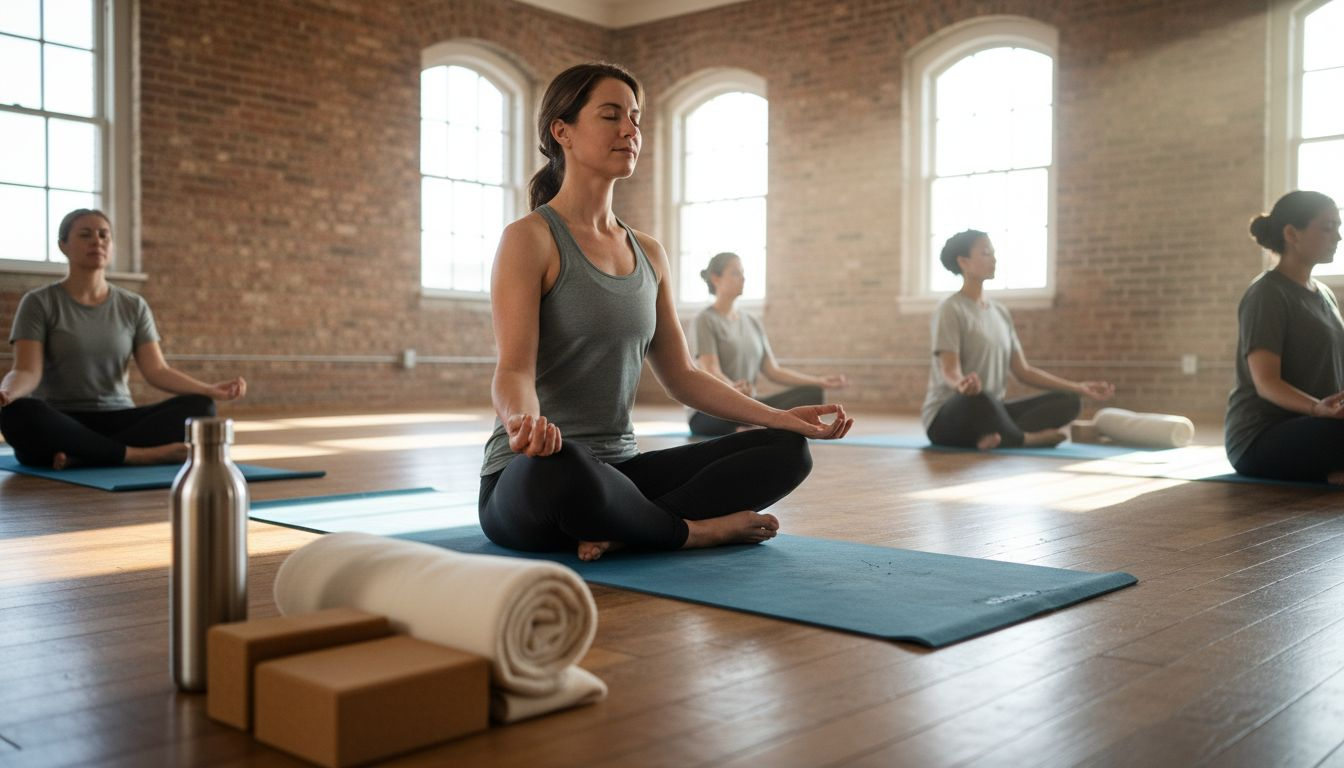
Set up a relaxed seated position
- Sit with your spine comfortably upright.
- Allow your shoulders to settle rather than lifting them toward your ears.
- Keep your head balanced rather than tipping your chin sharply up or down.
- Rest your hands wherever they feel natural.
- Close your eyes if that makes it easier to notice the breath.
You may use Chin Mudra or Gyan Mudra by lightly touching the index finger and thumb. Adi Mudra is another option. These hand positions are optional; resting the hands comfortably is sufficient.
What if sitting is uncomfortable?
Ujjayi can also be practiced in a comfortable lying position. Makarasana, a resting posture performed lying on the front, is another traditional option.
If you have back pain, sciatica, or a disc problem, do not assume that kneeling or lying on your front will automatically be suitable. Choose a position that does not aggravate your symptoms and obtain guidance when needed.
Before changing the breath, take a few ordinary breaths. Notice whether your jaw, shoulders, or abdomen are already tense. Let those areas soften as much as possible. This establishes a useful baseline: the Ujjayi breath should feel controlled, but not more distressed than your normal breathing.
Step 3: Learn the Ocean Sound With Your Mouth Open
The easiest way to discover the Ujjayi throat sensation is to begin with an open mouth. This is a learning exercise, not the final form of the practice.
Imagine gently fogging a mirror with your breath. That action introduces the soft throat adjustment used in Ujjayi. The important word is gently: you are not trying to blast warm air onto the mirror.
Try the open-mouth exercise
- Open your mouth slightly and relax your jaw.
- Exhale softly as though misting a mirror.
- Notice the quiet rushing sensation at the back of the throat.
- Inhale with a similarly light throat adjustment.
- Repeat for a few comfortable breaths.
You can rest a hand lightly near the throat to bring attention to the area, but do not press against it. The purpose is awareness, not manipulation.
The breath may sound a little like a quiet sigh or a soft ocean wash. Do not deliberately imitate harsh snoring. A rough, scraping sound is not the goal.
Use less effort than you think you need
A common beginner mistake is to make the throat narrowing too strong. The sound becomes obvious, but the breathing becomes uncomfortable. That reverses the priorities of the practice.
The correct order is:
- Maintain an easy passage of air.
- Introduce a small throat adjustment.
- Allow a subtle sound to appear.
If you feel throat irritation, a choking sensation, or an urge to cough, return to ordinary breathing. On your next attempt, reduce the effort instead of trying to push through.
You do not need to perfect both directions immediately. If the exhalation is easier to recognize, learn that sensation first. Then explore whether you can preserve the same softness during inhalation.
Step 4: Close Your Lips and Continue Through the Nose
Once you recognize the open-mouth sensation, transfer it to nasal breathing. This is the central skill in basic Ujjayi pranayama.
The throat adjustment stays gentle, but the mouth closes. Air enters and leaves through the nostrils, while the quiet sound is formed farther back in the throat.
Set the mouth and jaw
- Bring the lips together softly.
- Keep the teeth slightly apart rather than clenching them.
- Let the tongue rest comfortably, without pressing it firmly upward.
- Keep the jaw relaxed.
Inhale through your nose while maintaining a slight narrowing of the throat. Exhale through your nose with the same quality. Think of carrying the sensation from the open-mouth exercise into a quieter, closed-mouth breath.
If the sound disappears, do not immediately tighten harder. Try one more gentle open-mouth exhalation to remind yourself of the sensation, then close the lips again.
How loud should Ujjayi be?
For this quiet, standalone practice, aim for a sound that is primarily audible to you. It is an internal attention cue, not a performance for people nearby.
The sound should help you listen to the breath, not compete with the effort of breathing. If making it louder causes neck tension or stronger breathing, soften it.
Some breaths may be clearer than others while you learn. That is not a reason to force every inhalation and exhalation to sound identical. Prioritize an even, comfortable airflow.
Practice three easy nasal Ujjayi breaths, then return to normal breathing. This short sequence lets you compare the two. The Ujjayi breath should feel more deliberate and audible, but it should not leave you desperate for the next breath.
Step 5: Coordinate Ujjayi With a Comfortable Full Breath
After learning the throat action, bring attention to how the breath moves through the body. The aim is a comfortable, fuller breathing pattern rather than repeated maximum inhalations.
In a full yogic breath, awareness follows the expansion from the abdomen toward the chest. The upper part of the breath may be felt around the upper chest and throat, but air is not being stored in the throat or drawn into the navel.
Follow the breath from the lower to the upper areas
- Begin inhaling, allowing the abdomen to expand comfortably.
- Let the expansion continue into the chest.
- Maintain the soft Ujjayi sound without lifting or tightening the shoulders.
- Exhale steadily, allowing the chest and abdomen to settle.
- Repeat without forcing either the inhale or the exhale.
This sequence is a way to organize attention. It should not become a rigid demand to move each region separately or dramatically.
Think full enough to feel spacious, not “as full as physically possible.” Overfilling the breath can make the next phase tense and interrupt the smooth rhythm you are trying to establish.
Should you tighten the abdomen?
You may notice a subtle sense of engagement around the upper abdomen as the breath becomes more controlled. Do not turn that observation into an instruction to brace hard or pull the belly inward throughout inhalation.
The basic practice does not require a strong abdominal lock. Keep the abdomen responsive to breathing rather than deliberately immobilizing it.
A useful check is whether you can maintain the throat sound while the rest of the body remains relatively quiet. If your shoulders rise, your jaw clenches, or your abdomen becomes rigid, simplify the breath. Use a smaller inhalation and release unnecessary effort before continuing.
Step 6: Establish an Even Rhythm Without Chasing Long Counts
A steady rhythm makes Ujjayi easier to follow. For beginners, a comfortable balance between inhalation and exhalation is more useful than an ambitious timing target.
Mental counting can help. Count quietly as you inhale, then use the same comfortable count as you exhale. The count should support the breath, not dictate a length that your body cannot manage easily.
Longer counts, such as ten or twelve, belong only where they remain natural and unforced. They are not entry requirements, and a mental count should not automatically be interpreted as a fixed number of seconds.
Find your own starting rhythm
- Take one easy Ujjayi inhalation without counting.
- Notice roughly how long it feels comfortable.
- On the next breath, add a gentle mental count.
- Use a comparable count for the exhalation.
- Shorten both phases if either becomes strained.
The important result is continuity. You should not need to accelerate at the end of the exhale, gulp the next inhale, or pause because the count has exhausted you.
Should the exhalation be longer?
Ujjayi can make it easier to notice and gradually smooth the exhalation. However, a beginner does not need to impose a dramatically longer exhale.
Start with balanced breathing. If the exhalation naturally becomes a little more spacious while remaining comfortable, let that happen without turning it into a competition.
Longer is not automatically better. The useful signs are ease, steadiness, and your ability to maintain attention without struggling.
If counting makes you anxious or overly mechanical, leave it out. Listen to the soft sound instead. Counting and listening are both attention tools; neither should interfere with breathing comfortably.
Step 7: Build a Short Practice You Can Repeat Comfortably
Once the technique feels familiar, combine posture, nasal breathing, the soft throat sound, and an even rhythm into a short session.
A few breaths are enough for the first learning attempts. As comfort develops, a session of around three minutes provides a practical starting point. Five to ten minutes can be an option later, provided the breath remains easy throughout.
These durations are practice guidelines, not guaranteed thresholds for a particular result. A shorter, comfortable session is preferable to a longer one filled with strain.
A simple beginner practice
- Settle: Find a comfortable position and allow a few ordinary breaths.
- Recall the sensation: If needed, use a gentle open-mouth mirror-fogging exhale.
- Close the lips: Relax the jaw and begin nasal Ujjayi.
- Find the rhythm: Keep inhalation and exhalation smooth and comfortably balanced.
- Listen: Let the quiet sound hold your attention.
- Finish: Release the throat adjustment and return to natural breathing.
During early practice, try a few breaths at a time. Once that is easy, you can explore ten to fifteen consecutive breaths before deciding whether to extend the session.
When can you practice?
Ujjayi is flexible enough to fit into different parts of the day. Common uses include a quiet pause after work, preparation for meditation, or a gentle settling practice before sleep.
If you use it at bedtime, keep the practice soft. There is no need to add breath-holding or turn it into an intense exercise.
Choose a setting where you can focus on your breathing. Although the technique does not require a complex setup, flexibility should not be mistaken for the need to practice continuously or during every activity.
Step 8: Check Your Technique and Correct Common Mistakes
The best way to evaluate Ujjayi is to consider the whole experience, not just the sound. A convincing ocean noise does not prove that the technique is comfortable or well-controlled.
Use this technique checklist
- The breath passes through the nose once the learning exercise is complete.
- The lips meet softly, while the jaw remains unclenched.
- The sound is quiet and mainly noticeable to you.
- The throat feels gently adjusted, not squeezed or irritated.
- Inhalation and exhalation remain continuous.
- The shoulders and face stay relaxed.
- You can return to ordinary breathing without gasping.
Mistake: Making the sound too loud
A louder sound usually calls for more effort, not necessarily better technique. Reduce the throat narrowing and take a smaller breath. Let the sound become subtle.
Mistake: Forcing very deep breaths
Do not repeatedly fill the lungs to an uncomfortable maximum. Ujjayi is a controlled breathing practice, not a test of how much air you can draw in.
Mistake: Tightening the entire neck
The intended action is local and light. If the neck, jaw, and shoulders all tense together, pause. Return to the open-mouth exercise with less effort, then try nasal breathing again.
Mistake: Continuing through throat irritation
Itching, roughness, hiccup-like interruptions, or coughing are reasons to soften or stop, not signs that the practice is working more deeply.
Mistake: Treating the count as compulsory
If a chosen count makes the breath uneven, shorten it. The technique should adapt to your comfort level rather than force you to meet a number.
If you become dizzy, feel short of breath, or experience other concerning symptoms, stop the exercise and return to ordinary breathing. Seek medical advice if symptoms persist. Do not try to correct discomfort by breathing harder.
Step 9: Use Ujjayi for Relaxation While Keeping Benefits in Perspective
Ujjayi is traditionally used to calm the mind, support concentration, and help the body settle. Its soft sound provides a consistent sensory focus, while the deliberate rhythm encourages you to stay with the present breath.
These are useful practice aims. They should be distinguished from claims that Ujjayi cures disease, purifies the blood, guarantees increased oxygen delivery, or balances the two sides of the brain.
Relaxation and mental steadiness
The basic exercise gives you a simple task: listen, breathe comfortably, and return attention when it wanders. You do not need to eliminate every thought for the practice to be worthwhile.
If your attention drifts, notice the next inhalation or exhalation. The sound serves as a reminder rather than a demand to concentrate perfectly.
Preparation for meditation
A short Ujjayi session can act as a transition into meditation. Begin with the audible breath, then release the throat adjustment and continue observing natural breathing.
This allows the technique to support meditation without requiring you to maintain a controlled breath for the entire sitting period.
Sleep and winding down
Gentle Ujjayi before bed may help you establish a calmer evening routine. However, it is not a guaranteed treatment for insomnia or snoring. Persistent sleep problems deserve appropriate assessment rather than repeated attempts to solve them with breathing alone.
Does Ujjayi help thyroid problems?
Ujjayi is often included in traditional discussions of yoga for the throat and thyroid. Working near the throat does not, by itself, establish that the practice treats thyroid disease or normalizes thyroid hormone levels.
Do not replace thyroid medication, testing, or medical advice with Ujjayi pranayama. If you have a diagnosed condition, discuss the suitability of breathing exercises and neck positions with your clinician.
What about asthma, blood pressure, and anxiety?
The gentle version may be approached as a relaxation practice where appropriate, but it should not be presented as a substitute for treatment. People with heart, lung, or blood pressure conditions should avoid the breath-holding and chin-lock variation.
Similarly, feeling calmer during practice is different from treating depression or an anxiety disorder. Keep expectations practical: observe whether the exercise feels comfortable and helps you settle, without assuming a medical outcome.
Step 10: Treat Breath Retention and Chin Lock as a Separate Advanced Practice
Basic Ujjayi is complete without breath holding. You do not need to advance beyond it to use the technique for attention or relaxation.
The advanced variation combines an inhalation with Antar Kumbhaka, meaning internal breath retention, and Jalandhara Bandha, the chin lock. This adds coordination and places different demands on the practice.
Learning a quiet ocean sound for a few breaths is not enough preparation to automatically add these elements.
Understand the sequence before attempting it
At a conceptual level, the sequence is:
- Inhale using Ujjayi.
- Retain the breath comfortably.
- Apply the chin lock with appropriate instruction.
- Release the chin lock before exhaling.
- Exhale smoothly with Ujjayi.
The release order matters: the chin lock is released before the exhalation. The movement should not be treated as forceful neck bending or head pressing.
For background on the technique, see this Jalandhara Bandha instruction. Written steps or demonstrations are not a substitute for individualized guidance when learning advanced breath retention.
Do not chase a holding time
A prescribed retention duration should not become a target that overrides comfort. Avoid copying a holding time simply because another practitioner can manage it.
If you have high blood pressure, heart disease, asthma, or another lung condition, leave out both retention and the chin lock. If you are uncertain about suitability, remain with ordinary breathing until you receive appropriate guidance.
For most beginners, the next step is not a more complicated technique. It is greater ease in the basic one: a softer sound, a steadier rhythm, and less unnecessary tension.
The most useful Ujjayi practice is one you can repeat comfortably. Start with a few quiet nasal breaths, keep the throat adjustment minimal, and stop before effort replaces ease. Consistent, attentive practice matters more than loudness, long counts, or advanced variations.








Leave A Comment
You must be logged in to post a comment.